





This article explores the Orchidaceae family: defining traits, diversity, evolution, and importance.
“No group of plants has captivated human imagination quite like the orchids—masters of beauty, deception, and evolutionary innovation.”— The Economic Botanist
You may know orchids as elegant houseplants or exotic flowers in tropical gardens—but the Orchidaceae family is far more than ornamental beauty. It is the largest family of flowering plants on Earth, renowned for its astonishing diversity, complex flowers, and remarkable ecological relationships.
From rainforests and cloud forests to grasslands and temperate meadows, orchids have evolved to survive in some of the most challenging environments on the planet. Their success lies in highly specialized floral structures, intimate pollination strategies, and extraordinary partnerships with fungi.
In this article, we’ll explore the Orchidaceae family: how orchids are classified, how their flowers function, where they grow, why they matter ecologically and economically, and how people cultivate them around the world.
Whether you’re a plant enthusiast, gardener, biology student, or orchid admirer, this guide will give you a deeper appreciation for one of nature’s most fascinating plant families.
- Orchidaceae Family Overview
- Characteristics of the Orchidaceae Family
- Orchid Subfamilies
- Major Genera in the Orchidaceae
- Common Orchid Species
- Economic and Ecological Importance
- Evolution and Phylogeny of Orchidaceae
- Distribution and Habitat
- Uses and Applications of Orchids
- Cultivation and Care Tips
- The Bottom Line
Orchidaceae Family Overview
The Orchidaceae family contains over 28,000–30,000 species across more than 760 genera, making it the largest family of flowering plants (angiosperms).
Orchids can be found on every continent except Antarctica and include:
- Epiphytic orchids (growing on trees)
- Terrestrial orchids (growing in soil)
- Lithophytic orchids (growing on rocks)
Despite their exotic reputation, many orchids thrive in temperate climates and even appear as wildflowers in forests and meadows.
What truly distinguishes Orchidaceae is their highly specialized flower structure, designed for precision pollination.
Characteristics of the Orchidaceae Family
Unique Flower Structure
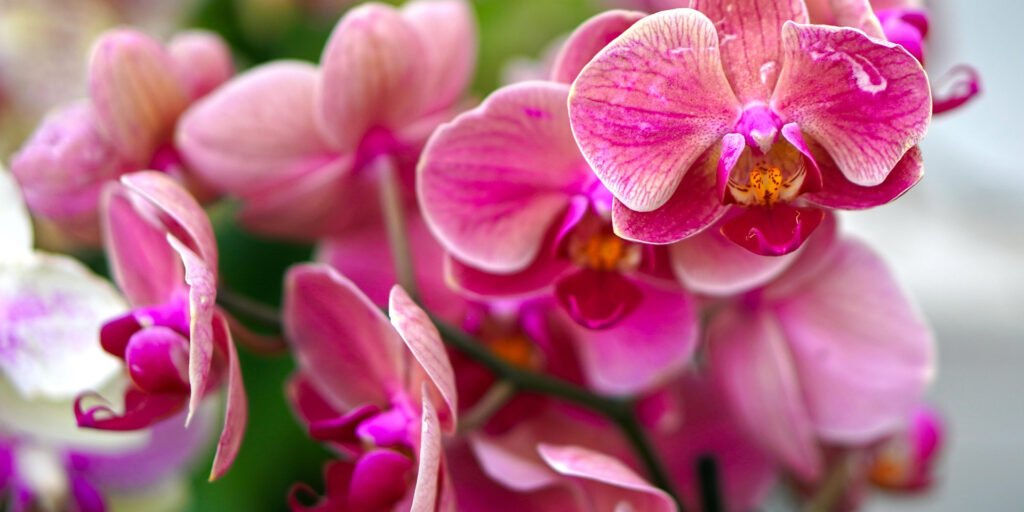
Orchid flowers are bilaterally symmetrical and highly modified. Key features include:
- Three sepals and three petals
- One petal modified into a labellum (lip) for pollinator attraction
- A fused reproductive column called the gynostemium
- Pollinia (packed pollen masses instead of loose grains)
This design ensures extremely efficient—and often species-specific—pollination.
Advanced Pollination Strategies
Orchids are famous for pollination tricks, including:
- Mimicking insects (sexual deception)
- Producing nectar guides
- Releasing fragrances at precise times
- Forcing pollinators into exact positions
Some orchids rely on a single pollinator species for survival.
Roots and Growth Habits
Orchid roots are distinctive:
- Often covered in velamen, a spongy tissue that absorbs moisture
- Adapted for air exposure in epiphytic species
- Capable of photosynthesis in some orchids
Growth forms include monopodial (single stem) and sympodial (multiple shoots).
Seeds and Germination
Orchid seeds are microscopic and lack stored nutrients. To germinate, they require a symbiotic relationship with mycorrhizal fungi, making orchids deeply dependent on their ecosystems.
Orchid Subfamilies
Botanists divide Orchidaceae into several subfamilies. The most prominent include:
Epidendroideae
- Largest subfamily
- Mostly epiphytic tropical orchids
- Includes Phalaenopsis, Cattleya, Dendrobium
Orchidoideae
- Mostly terrestrial orchids
- Includes Orchis and Habenaria
- Common in temperate regions
Vanilloideae
- Includes the vanilla orchid
- Climbing vines with economic importance
Cypripedioideae
- Known as slipper orchids
- Includes Paphiopedilum and Cypripedium
Major Genera in the Orchidaceae
Phalaenopsis (Moth Orchids)
- Popular houseplants
- Long-lasting blooms
- Beginner-friendly
Cattleya
- Large, fragrant flowers
- Iconic corsage orchids
Dendrobium
- One of the largest genera
- Diverse growth habits and climates
Vanilla
- Source of natural vanilla flavoring
- One of the few agriculturally cultivated orchids
Paphiopedilum
- Slipper-shaped flowers
- Native to Southeast Asia
Common Orchid Species
Notable Orchidaceae species include:
- Phalaenopsis amabilis
- Cattleya labiata
- Vanilla planifolia
- Cypripedium calceolus
- Dendrobium nobile
- Orchis mascula
Each represents a unique evolutionary adaptation.
Economic and Ecological Importance
Horticulture and Floriculture
Orchids are among the most valuable ornamental plants globally, dominating:
- Cut flower markets
- Houseplant industries
- Botanical collections
Ecological Roles
Orchids contribute to ecosystems by:
- Supporting specialized pollinators
- Acting as indicators of ecosystem health
- Participating in complex fungal networks
Their presence often signals intact habitats.
Cultural and Medicinal Uses
- Vanilla as a global flavoring
- Traditional medicines in Asia and the Americas
- Cultural symbolism of beauty, love, and refinement
Evolution and Phylogeny of Orchidaceae
Orchidaceae likely originated over 80 million years ago, evolving alongside insects. Their rapid diversification is attributed to:
- Specialized pollination
- Mycorrhizal dependency
- High reproductive efficiency
Genetic studies continue to uncover surprising relationships among orchid groups.
Distribution and Habitat
Orchids grow in:
- Tropical rainforests
- Cloud forests
- Grasslands
- Temperate woodlands
- Alpine regions
Tropical regions host the greatest diversity, but temperate orchids are widespread and ecologically important.
Uses and Applications of Orchids
Ornamental Uses
- Houseplants
- Landscape features
- Floral arrangements
Culinary Uses
- Vanilla flavoring
- Traditional beverages (e.g., salep)
Medicinal and Cultural Uses
- Herbal remedies
- Religious and ceremonial traditions
Cultivation and Care Tips
Ideal Growing Conditions
- Bright, indirect light
- Excellent drainage
- Proper humidity and airflow
Watering and Feeding
- Avoid overwatering
- Use diluted orchid fertilizers
- Let roots dry slightly between waterings
Maintenance
- Repot every 1–2 years
- Remove spent flower spikes if desired
- Monitor for pests like scale and mealybugs
The Bottom Line
The Orchidaceae family represents the pinnacle of floral evolution—combining beauty, complexity, and ecological sophistication. From the vanilla in your kitchen to the orchids adorning windowsills and forests alike, these plants connect science, culture, and nature in extraordinary ways.
Understanding orchids isn’t just about admiring their flowers—it’s about appreciating one of the most successful and intricate plant families on Earth.
********************
Want to explore orchids even further? Subscribe to our blog for in-depth plant family guides, orchid care tutorials, and botanical insights—or browse our latest articles to deepen your understanding of the plant world, one family at a time.